
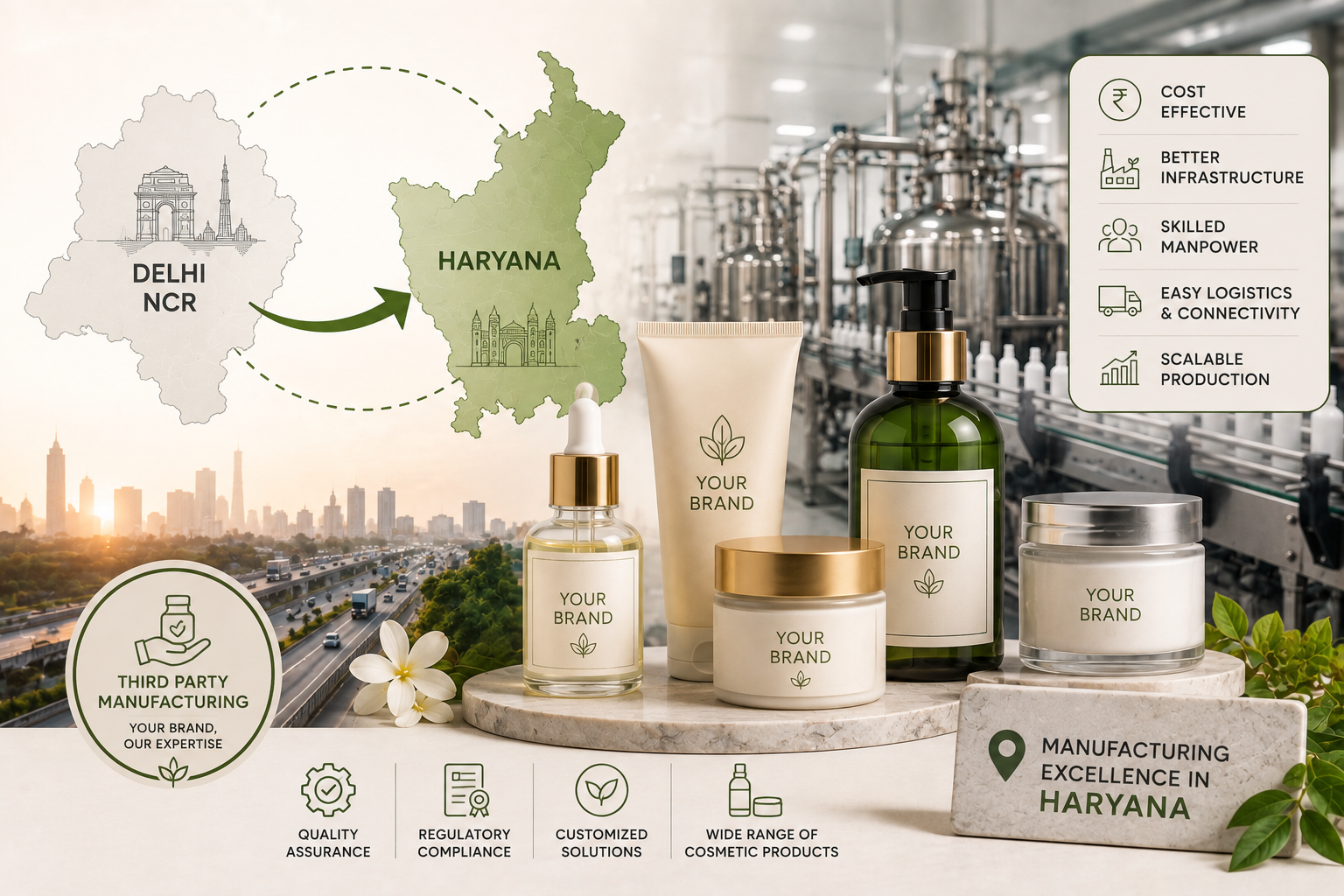
If you’re searching for third-party cosmetic manufacturers in Delhi NCR, you’ll find no shortage of options, Delhi, Gurugram, Noida, Panchkula, and Baddi all have established players. So why would an NCR brand look at Haryana instead?
Quick answer: Not because it’s automatically cheaper, but because a Karnal-based facility can offer NCR brands easier coordination, facility access, and a dedicated manufacturing environment, while your marketing, sales, and customer operations stay in Delhi-NCR. The decision should still come down to the manufacturer’s quality, compliance, formulation capability, MOQ, and scalability, not the pin code.
What Is Third-Party Cosmetic Manufacturing?
Third-party manufacturing means a brand partners with a manufacturer to produce cosmetic or personal-care products under the brand’s own name. The brand focuses on product selection, branding, marketing, and distribution; the manufacturer handles formulation, sourcing, filling, packaging, quality control, and dispatch. It’s the model most startups use instead of building and operating their own factory.
Part 1: Why Haryana Is a Practical Alternative
Location alone never guarantees a good manufacturing relationship, a supplier five kilometres away can still cause problems through poor communication, unclear MOQs, or inconsistent batches. But for Delhi-NCR founders, Haryana offers a few real practical advantages worth weighing:
- Proximity without the crowd. A Haryana-based manufacturer stays accessible for facility visits, sample reviews, and in-person production discussions, while sitting outside Delhi’s saturated commercial centre.
- A useful operational split. Brands can run marketing, e-commerce, and customer support from Delhi-NCR while production happens in Haryana, keeping brand operations and manufacturing cleanly separated.
- Karnal specifically connects Delhi-NCR with wider North Indian markets, which is why it comes up often in searches for a cosmetic manufacturer in Karnal. Shukti Food Pharma operates a GMP-certified facility there, offering private label, custom formulation, and contract manufacturing for Ayurvedic, skincare, and haircare products, with pan-India dispatch.
None of this means Haryana is automatically cheaper or better, a lower quote that leads to rejected batches, packaging failures, or delayed launches isn’t actually a deal. The right question isn’t “who’s cheapest,” it’s “who delivers the best total manufacturing value.”
Part 2: Comparing Locations
There’s no universal winner between Delhi-NCR, Haryana, Panchkula, and Baddi, each has real strengths, and the right one depends on your specific requirements.
| Factor | Delhi-NCR | Haryana (Karnal) | Panchkula | Baddi |
| Access for NCR brands | Excellent | Strong, often more practical for visits | Strong | Requires more travel |
| Manufacturing ecosystem | Established | Established and growing | Established | Large, mature industrial hub |
| Manufacturer variety | High | Moderate, growing | Moderate | Very high |
| Custom formulation, MOQ, quality | Manufacturer-dependent | Manufacturer-dependent | Manufacturer-dependent | Manufacturer-dependent |
The pattern across every comparison is the same: the manufacturer matters more than the city. Baddi has scale and a huge supplier network, which means more options to compare, and more due diligence needed. Panchkula and Karnal both serve skincare, haircare, and Ayurvedic categories with GMP-certified facilities. Don’t pick Baddi because “Baddi is famous for cosmetics,” and don’t pick Haryana because “it’s closer”, evaluate the actual facility against your product’s needs.
Part 3: 8 Things to Check Before Choosing a Manufacturer
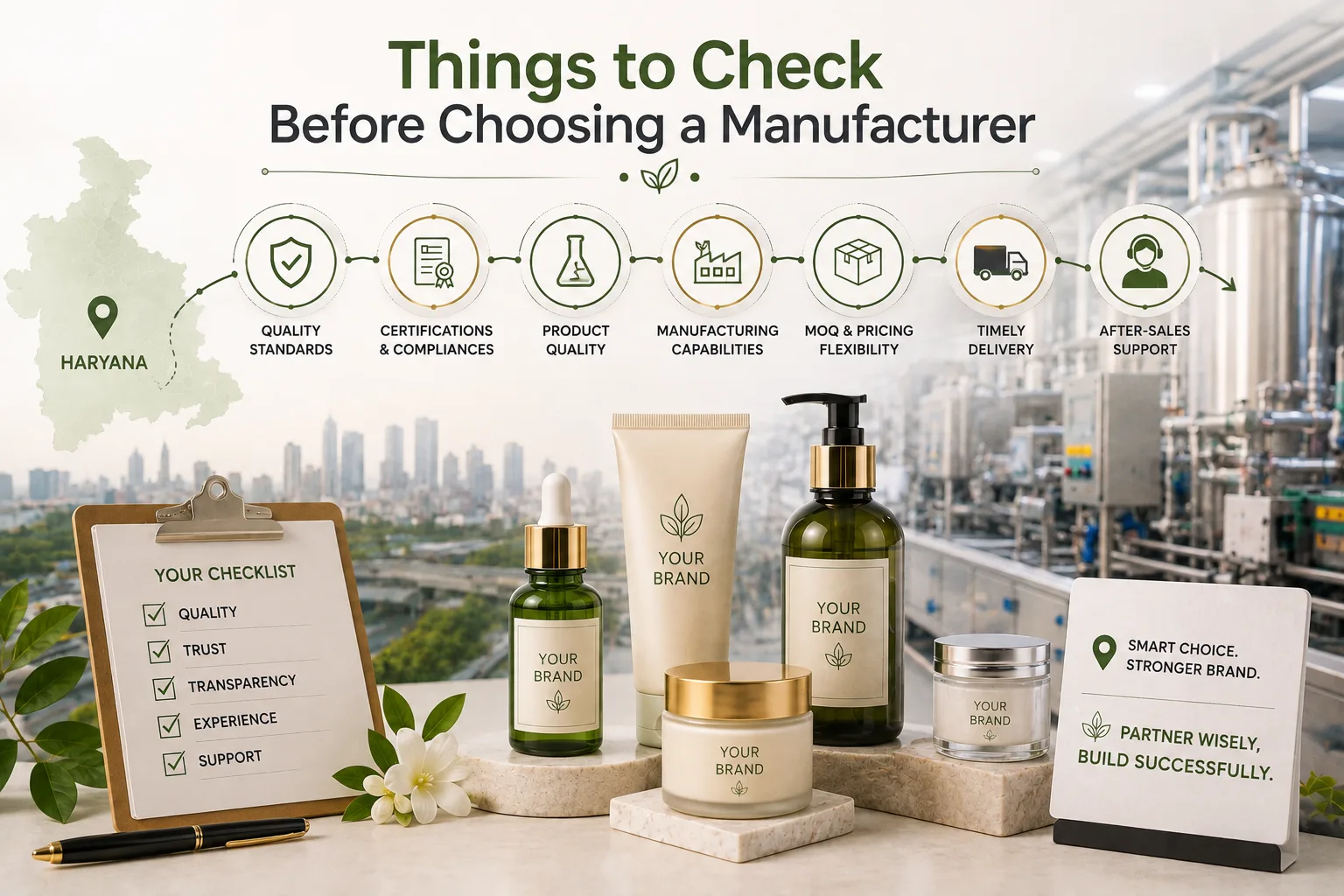
Run this checklist with every shortlisted manufacturer, in Delhi, Haryana, or anywhere else, before signing:
- Manufacturing licence and compliance. Cosmetic manufacturing in India sits under the Drugs and Cosmetics Act and the Cosmetics Rules, 2020. Ask what their licensing, testing, documentation, and labelling actually cover, “GMP certified” alone isn’t enough detail.
- GMP and quality systems. Ask about raw material checks, batch consistency, and finished-product testing. Your first batch being good isn’t the bar, your 10th and 20th need to match spec too.
- MOQ, asked three ways. What’s the MOQ per SKU? Does packaging carry a separate MOQ? Does it change for custom formulations? Get the full commercial structure before deciding, not just a headline number.
- Samples before commitment. Never approve production from a photo. Test texture, fragrance, appearance, and packaging performance, and document the approved specs before commercial runs.
- Formulation capability. Ask whether they offer ready formulations, custom development, and genuine R&D support, important if your goal is differentiation, not just a logo on an existing product. See formulation services for how this typically works.
- Packaging support. Confirm they handle bottles, jars, tubes, pumps, labels, and cartons, and get packaging MOQs confirmed separately from product MOQs.
- Lead times. Ask for realistic timelines across sample → approval → artwork → production → dispatch, and what happens if raw materials or packaging get delayed.
- Scalability. A good manufacturing relationship should work at 1,000 units and at 10,000 units. Ask specifically what happens when demand doubles.
Once you’ve run this checklist across 3–5 shortlisted manufacturers, compare samples and commercial terms side by side, visit the facility where practical, and start with a controlled batch before committing to larger volumes.
Part 4: Category-Specific Manufacturing
Capable manufacturers typically support three core categories, each with its own formulation and compliance nuances:
- Skincare, cleansers, serums, moisturizers, creams, sunscreens, and treatment formats. Browse skincare private label options or skincare manufacturing insights.
- Haircare, shampoos, conditioners, oils, serums, masks, and scalp-care products. Browse haircare private label options or haircare manufacturing insights.
- Ayurvedic, classical and modern herbal formulations. Browse Ayurvedic private label options or Ayurvedic manufacturing insights.
For the full catalogue, see Shukti Food Pharma’s product categories. For a deeper walkthrough of launching your first SKUs at low MOQ, see our guide on starting a private label cosmetic brand in India.
Part 5: Why Third-Party Manufacturing Beats Building Your Own Factory
Building a cosmetic manufacturing facility means premises, equipment, qualified technical staff, raw-material systems, quality control, licensing, and packaging infrastructure, a far bigger undertaking than most startups need for a first launch. Third-party manufacturing outsources that operational complexity, letting you focus on brand, product, marketing, and customers instead.
This model is drawing real investment in India, too, Naturis Cosmetics raised ₹100 crore in July 2026 specifically to expand contract manufacturing capacity, a sign of how much demand exists for this approach.
Why Shukti Food Pharma
If you’re specifically looking for a third-party cosmetic manufacturer in Haryana, Shukti Food Pharma operates a GMP-certified facility in Karnal offering private labelling, custom formulation, and contract manufacturing for Ayurvedic, skincare, and haircare products, with sampling, artwork guidance, and batch documentation built into the process. See the facility on Google Maps, or get in touch to discuss product requirements, MOQ, and pricing.
FAQs
Is Haryana better than Delhi for cosmetic manufacturing?
Not automatically. Haryana can be practical for Delhi-NCR brands due to location and industrial infrastructure, but the individual manufacturer matters more than the state.
Is Karnal good for cosmetic manufacturing?
Yes, for many North Indian and Delhi-NCR brands, though the decision should still rest on the manufacturer’s quality systems, compliance, MOQ, and scalability.
Panchkula or Karnal, which is better for third-party manufacturing?
Neither is universally better. Compare the actual manufacturers on quality, formulation capability, MOQ, compliance, and lead times.
Why is Baddi popular for cosmetic manufacturing?
Baddi has a large, mature industrial ecosystem with a high concentration of cosmetic and personal-care manufacturers, giving brands more suppliers to compare, and more due diligence to do.
Should Delhi-NCR brands choose Baddi or Haryana?
Compare specific manufacturers rather than choosing by geography. Haryana can be more convenient for NCR-based coordination; Baddi offers a larger established manufacturing base.
What should I check before selecting a third-party cosmetic manufacturer?
Licensing, GMP/quality systems, formulation capability, samples, packaging, MOQ, lead times, documentation, and scalability.
Final Verdict: Look Beyond the Address
The strongest manufacturing partner isn’t the one with the lowest price, the lowest MOQ, or the closest address, it’s the one that delivers the right product, at the required quality, on time, with proper compliance and room to scale. For many Delhi-NCR brands, a Karnal-based partner belongs on that shortlist alongside Delhi, Panchkula, and Baddi.
Your brand can be built in Delhi-NCR, your manufacturing partner doesn’t have to be.