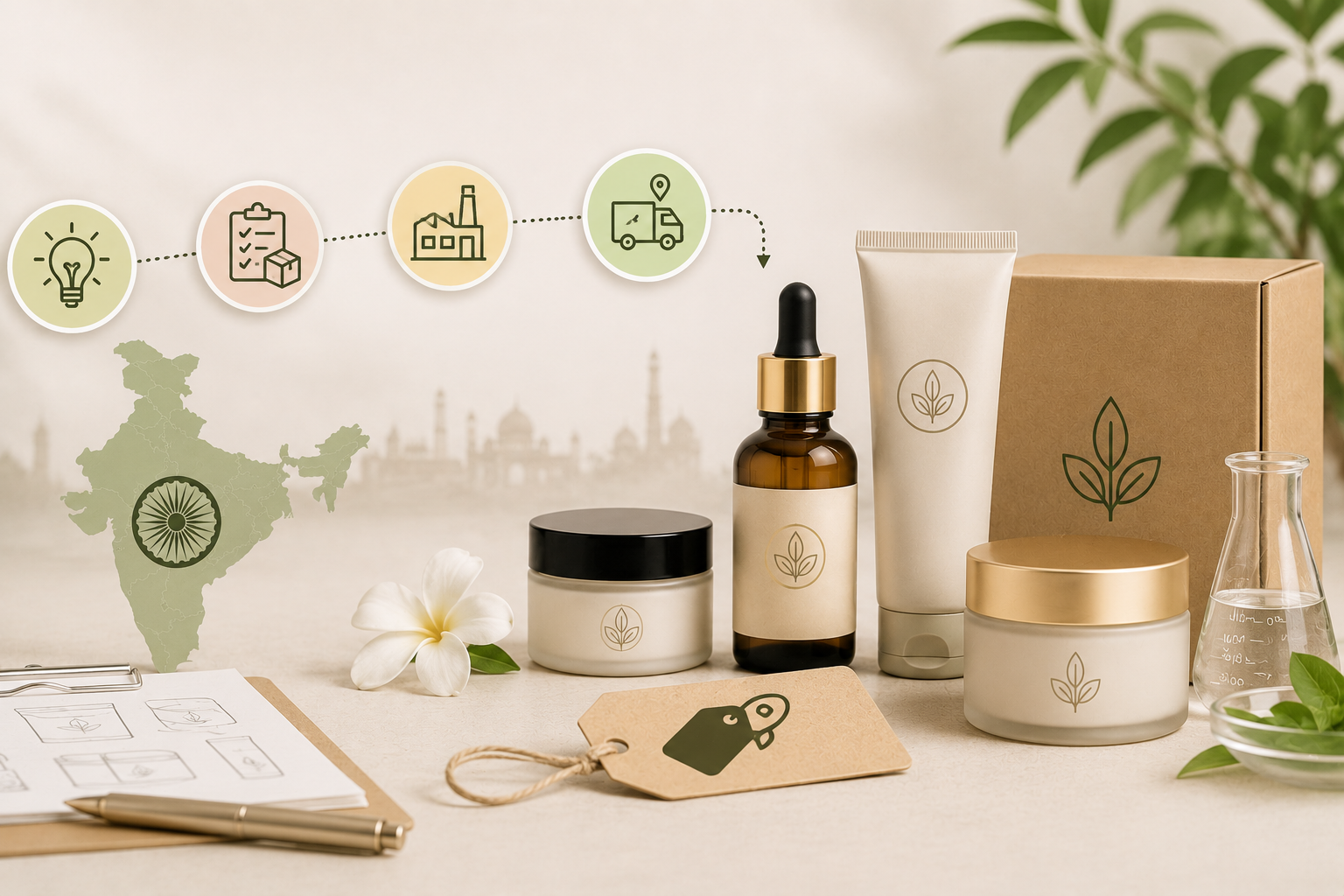
You don’t need a factory, a big team, or a warehouse full of stock to launch a cosmetic brand in India anymore. With the right private label cosmetic manufacturer, you can start with a handful of products, test whether people actually want to buy them, and scale up only once you have proof.
The hard part was never finding a manufacturer, it’s choosing the right products, understanding your customer, negotiating sane minimum order quantities (MOQs), and getting packaging and compliance right before you spend real money.
Quick answer: Yes, you can start a cosmetic brand in India on a small budget by partnering with a private label manufacturer instead of building your own production line, launching 1–3 hero products at a low MOQ (often 500–1,000 units per SKU), and reinvesting once demand is proven.
What Is Private Label Cosmetic Manufacturing?
Private label manufacturing means a manufacturer makes the product, a serum, shampoo, or cream, and you sell it under your own brand name. You control the name, packaging, positioning, and marketing; the manufacturer handles formulation and production, either from an existing formula or a custom one developed with their R&D team. This is different from reselling white-label goods, with private label, the product becomes a genuine part of your brand.
Private label vs. custom formulation:
- Private label suits founders who want to launch fast, keep development simple, and test demand before investing further.
- Custom formulation makes sense once you’ve validated the market and need a differentiated texture, active ingredient, or fragrance to stand apart.
Many first-time founders start with a proven private-label range, then move their best sellers toward custom formulations as the brand grows, see custom formulation services for how this typically works.
Part 1: Foundation, Niche, Competitors, and Your First SKUs
Pick a specific niche, not “everyone”
Don’t ask “which products should I make?” Ask “who exactly am I selling to?” India’s beauty market is crowded, so narrow it down: acne-prone skin, men’s grooming, scalp care, Ayurvedic skincare, or teen skincare are all workable starting points. “Simple daily skincare for oily, acne-prone skin” markets far more easily than “premium skincare for everyone.”
Study competitors, especially their bad reviews
Before approaching manufacturers, look at what’s already selling in your niche: ingredients, claims, pricing, packaging, and Amazon or D2C reviews. Negative reviews are gold, complaints about sticky serums, drying shampoos, white-cast sunscreens, or leaking pumps point directly to product gaps you could fill.
Launch with 1–3 strong SKUs
Skip the urge to launch ten products on day one. A tight starter range, say, a hero serum plus a cleanser and moisturizer, is easier to market and far less risky than a large catalogue sitting unsold in a warehouse. Validating a small SKU set first keeps capital from getting stuck in inventory.
Part 2: Manufacturing, MOQ, and Formulation
Find a genuinely low MOQ manufacturer
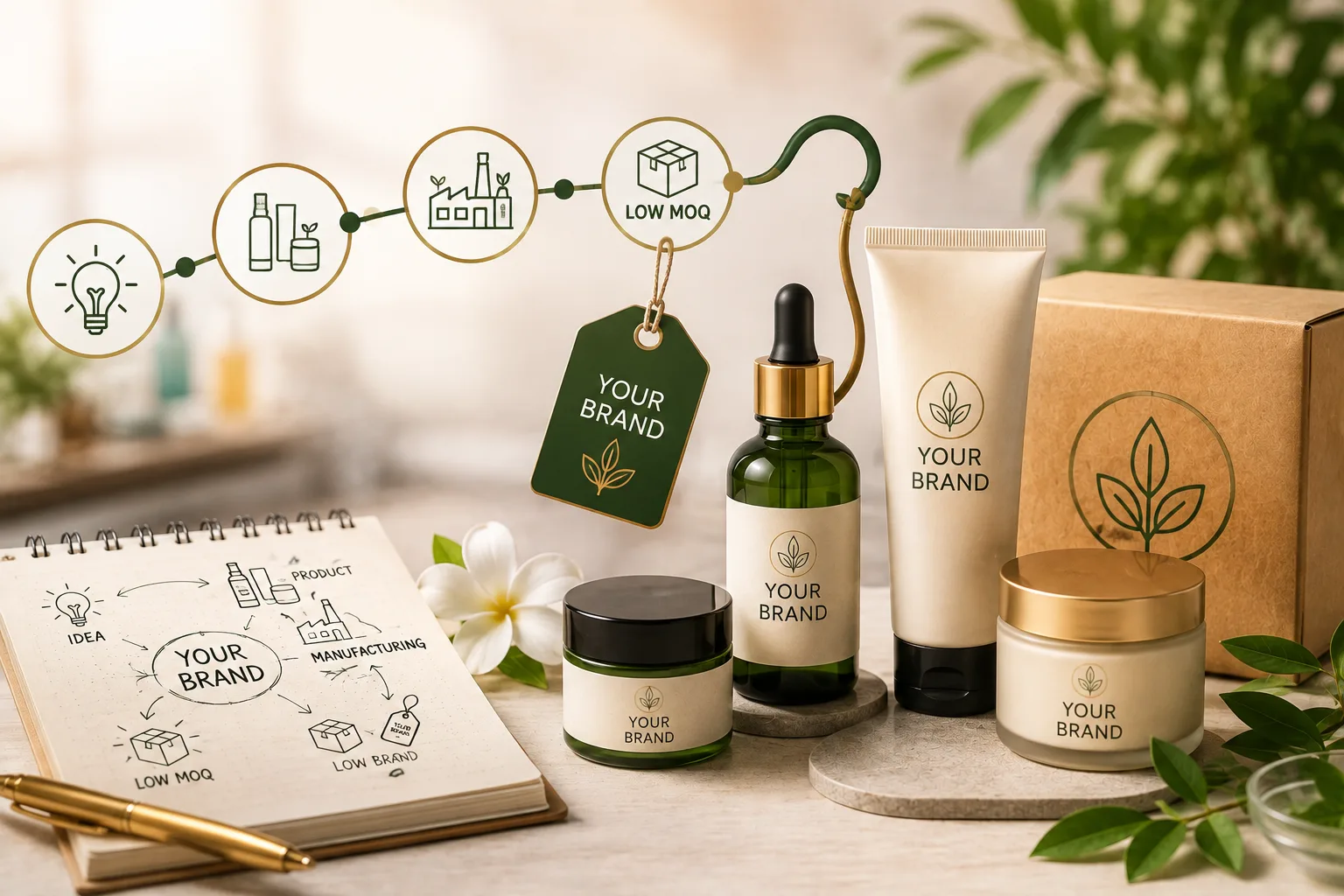
MOQ (Minimum Order Quantity) is the smallest batch a manufacturer will produce. A large order can lock up capital before you know if the product will sell, so don’t judge suppliers on MOQ alone, check MOQ per SKU, sample availability, packaging and labelling support, batch documentation, lead times, and payment terms. Shukti Food Pharma’s manufacturing services are built around this kind of low-MOQ, sample-first process.
Watch for the packaging trap: a manufacturer might quote a low formulation MOQ while custom-printed bottles or cartons carry a much higher minimum. Always request one combined quote covering formula, filling, packaging, labels, cartons, documentation, and logistics, not just a single headline number.
Choose stock or custom formulation
Stock (ready) formulations get you to market faster and keep your first run lean, ideal for testing demand. Custom formulation is worth the extra time and cost only when it gives customers a real reason to pick your product over a competitor’s, a specific active, texture, or fragrance profile. Don’t pay for “custom” just because it sounds premium. Read more on formulation approaches.
Always test samples first
Never commit to a commercial run based on a catalogue photo. Evaluate texture, absorption, fragrance, and skin feel, and have real users test the product. Check bottle and pump quality, cap fit, and label adhesion too. Then ask honestly: would your target customer pay your intended price for this?
Part 3: Compliance in India
Cosmetic manufacturing in India falls under the Drugs and Cosmetics Act, 1940 and the Cosmetics Rules, 2020, with licensing handled by State Licensing Authorities. Your manufacturer should be able to walk you through applicable licensing, ingredient compliance, batch documentation, labelling rules, and testing requirements. The CDSCO is explicit that cosmetic claims can’t be false or misleading, so don’t assume every “natural,” “herbal,” or “Ayurvedic” label is automatically fine. Confirm exact requirements with your manufacturer and a regulatory professional before commercial production.
Part 4: Category-Specific Considerations
Private label ranges typically span three areas. Each has its own formulation, claims, and compliance nuances worth understanding before you shortlist a manufacturer:
- Skincare, cleansers, creams, serums, sunscreens, body lotions, and treatment formats. Browse skincare private label options or skincare manufacturing insights.
- Haircare, oils, shampoos, conditioners, and scalp treatments. Browse haircare private label options or haircare manufacturing insights.
- Ayurvedic products, herbal and traditional-modern formulations, often requiring additional documentation. Browse Ayurvedic private label options or Ayurvedic manufacturing insights.
For the full catalogue across all three, see Shukti Food Pharma’s product categories.
Part 5: Cost, Pricing, and Packaging
Know your real product cost
Manufacturing cost is only one line item. Your true landed cost includes packaging, labels, cartons, testing, shipping, warehousing, marketplace fees, payment gateway charges, marketing, and returns. Customer acquisition cost in particular can dwarf your manufacturing spend once you start running Meta or Google ads, so calculate your contribution margin before you set a retail price, not after.
Price strategically, not by copying competitors
Before launch, you should know three numbers: landed cost (what one sellable unit truly costs), selling price (what the customer pays), and contribution margin (what’s left after variable costs). Factor in manufacturing, packaging, competitor pricing, marketplace commission, taxes, and desired margin, copying a competitor’s price without this math is a common early mistake.
Keep packaging lean at low MOQs
Custom bottles and printed cartons often carry higher minimums than the product itself. If low inventory is the goal, ask your manufacturer about standard packaging formats that can carry your branded labels, credible and functional matters more than expensive.
Part 6: Branding, Launch, and Scale
Your product is only half the business. You’ll also need a brand identity (name, logo, colours, packaging style), a digital presence (website, Instagram, WhatsApp Business, marketplace listings), and content that goes beyond “buy our serum”, explaining the problem, why it happens, and how your product fits into the customer’s routine. For positioning and marketing angles, see brand and industry trends.
Test, then scale:
- Validate, pick 1–3 products, sample, finalize packaging and pricing.
- Launch, website, Instagram, creator content, WhatsApp, marketplaces, controlled paid ads.
- Measure, orders, conversion rate, CAC, AOV, repeat purchase rate, returns.
- Scale, once a product shows consistent demand, increase production, improve margins, and add complementary SKUs.
7 mistakes new cosmetic brands make
- Launching too many SKUs at once
- Choosing the cheapest manufacturer over the most consistent one
- Ignoring which MOQ applies to formula vs. packaging vs. labels
- Skipping samples before a commercial order
- Making unsupported “natural” or “herbal” claims
- Overspending on packaging instead of the product
- Manufacturing before validating demand
Why Haryana works well for Delhi-NCR brands
For founders building a cosmetic brand in Delhi NCR, manufacturing location matters for sampling, communication, and production coordination. Shukti Food Pharma is based in Karnal, Haryana, offering private label, custom formulation, and contract manufacturing for skincare, haircare, and Ayurvedic ranges with low-MOQ support, sampling, documentation, and pan-India dispatch, see the facility on Google Maps. Location should support your evaluation, though, not replace it. Weigh quality, compliance, formulation capability, MOQ, and communication together.
FAQs
What is the minimum order quantity for private label cosmetics in India?
It varies by manufacturer, product, and packaging, there’s no universal MOQ. Always ask for the finished-product MOQ and the packaging MOQ separately.
How much money do I need to start a cosmetic brand in India?
There’s no fixed figure; it depends on SKU count, formulation, packaging, testing, branding, website, and marketing. A low-MOQ approach mainly reduces your initial inventory investment.
Can I start a skincare brand without owning a factory?
Yes, private label and contract manufacturing let you work with an established manufacturer instead of building your own facility. Confirm the licensing and compliance responsibilities for your specific arrangement.
How do I find a low MOQ cosmetic manufacturer?
Shortlist on MOQ, product categories, quality systems, formulation capability, sample process, packaging, documentation, and lead time, not MOQ alone.
Should I start with one product or several?
For most first-time founders, one hero product or a small complementary range is easier to manage than a full catalogue on day one.
Final Takeaway
Starting a cosmetic brand in India doesn’t require manufacturing hundreds of SKUs from day one. Choose a clear customer, solve a specific problem, launch a small focused range, partner with a reliable manufacturer, validate demand, and scale what actually sells.
If you’re building a new skincare, haircare, or Ayurvedic brand, explore Shukti Food Pharma’s low-MOQ private label manufacturing services or get in touch to discuss samples, MOQ, and pricing.