

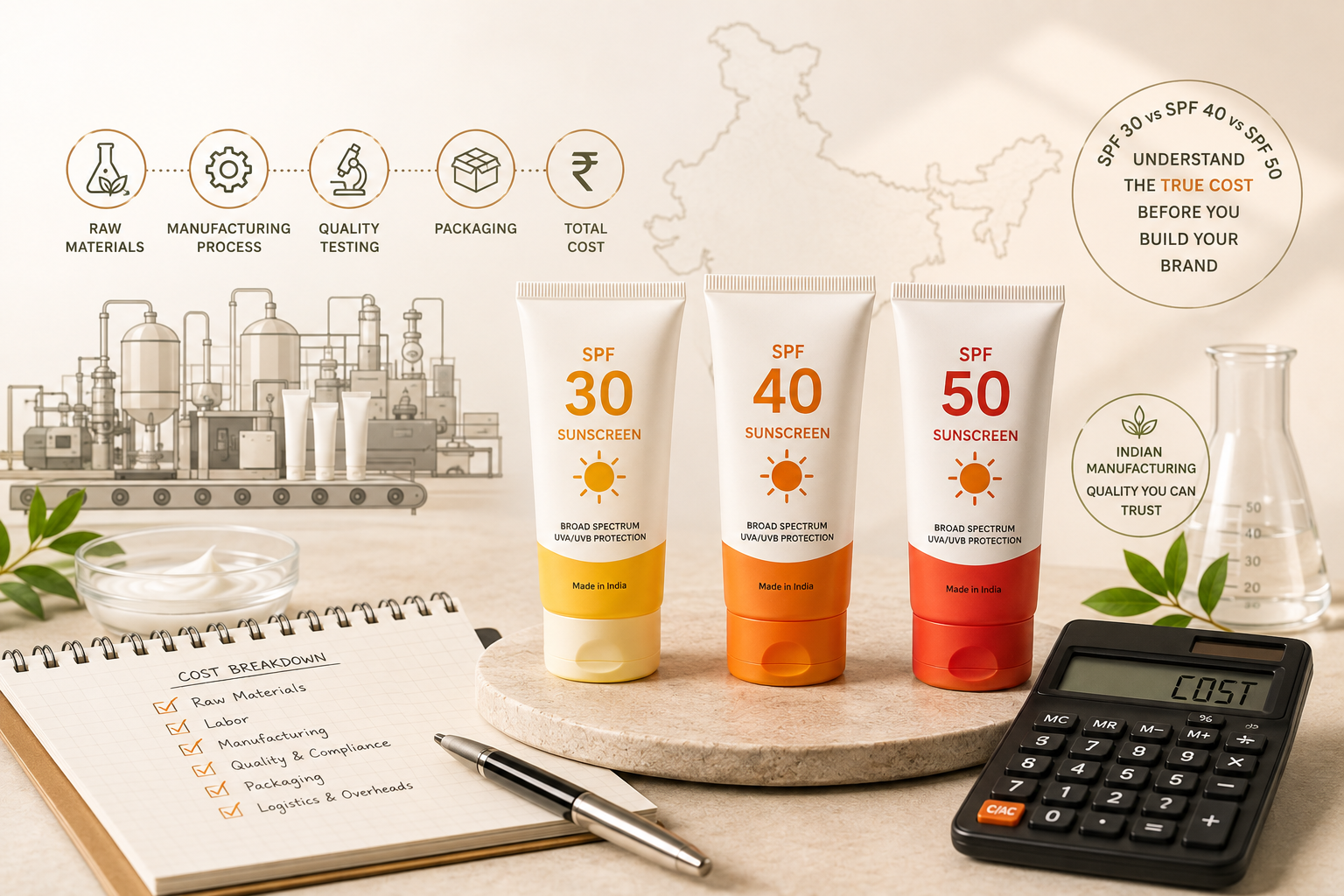
If you’re talking to a sunscreen manufacturer in India, the first question is usually: how much does SPF 30, SPF 40, or SPF 50 actually cost to make?
Quick answer: There’s no fixed per-unit price. Two sunscreens in identical 50 ml tubes can cost very differently depending on the UV filter system, texture, packaging, testing, and MOQ, not the SPF number alone. Comparing manufacturers on cost-per-tube misses most of what actually drives the price.
The Real Cost Formula
A manufacturing quote is only part of what you’ll actually spend. The useful calculation looks like this:
Total product cost = Formula + Manufacturing + Filling + Primary packaging + Label + Secondary packaging + Testing/documentation + Development + Logistics
Total cost of sale = Landed cost + Marketing + Selling expenses + Taxes/fees
If a manufacturer quotes ₹100 per unit, that ₹100 is rarely the full amount it costs you to get the product into a customer’s hands. Public supplier listings for SPF 50 sunscreen currently range from roughly ₹90 to ₹125 per piece at similar MOQs, a gap that reflects differences in specification, not one “correct” market price. Treat any online ₹/unit figure as a reference point, not a budget.
Sunscreen also costs more to formulate correctly than a basic cream, because the UV filter system, emulsion stability, and skin feel all need to hold up together while still delivering the tested protection level.
SPF 30 vs. 40 vs. 50: Comparing the Real Cost Drivers
A common assumption is that SPF 50 must cost dramatically more than SPF 30. Not necessarily, the SPF number is one input among several, and formulation, filter system, and testing usually matter more than the label claim itself.
What’s non-negotiable: SPF is a tested claim, not a marketing number. A draft Indian sunscreen standard (BIS) defines SPF 30 as a measured 30.0–39.9, SPF 40 as 40.0–49.9, and SPF 50 as 50.0–59.9, each requiring the applicable test method to support the label. A manufacturer shouldn’t raise the number on a label just because a brand wants a “premium” position.
| SPF | Typical positioning | Cost reality |
| SPF 30 | Everyday, entry-level, lightweight daily use | Cost driven by texture and filters, not the SPF number, a sophisticated SPF 30 gel can cost more than a basic SPF 50 lotion |
| SPF 40 | Higher protection without SPF 50 as the headline | Often priced by added actives, sensory upgrades, or packaging, compare full specification, not just the number |
| SPF 50 | Strong protection-focused positioning | Needs to deliver on white cast, greasiness, and finish, a good SPF 50 experience costs more than the SPF claim alone suggests |
Shukti Food Pharma’s catalogue currently includes SPF 30 gel, SPF 40 matte, and SPF 50 lotion and matte formats, so you can compare specifications directly rather than guessing from a single quoted number.
The 7 Factors That Actually Drive Cost
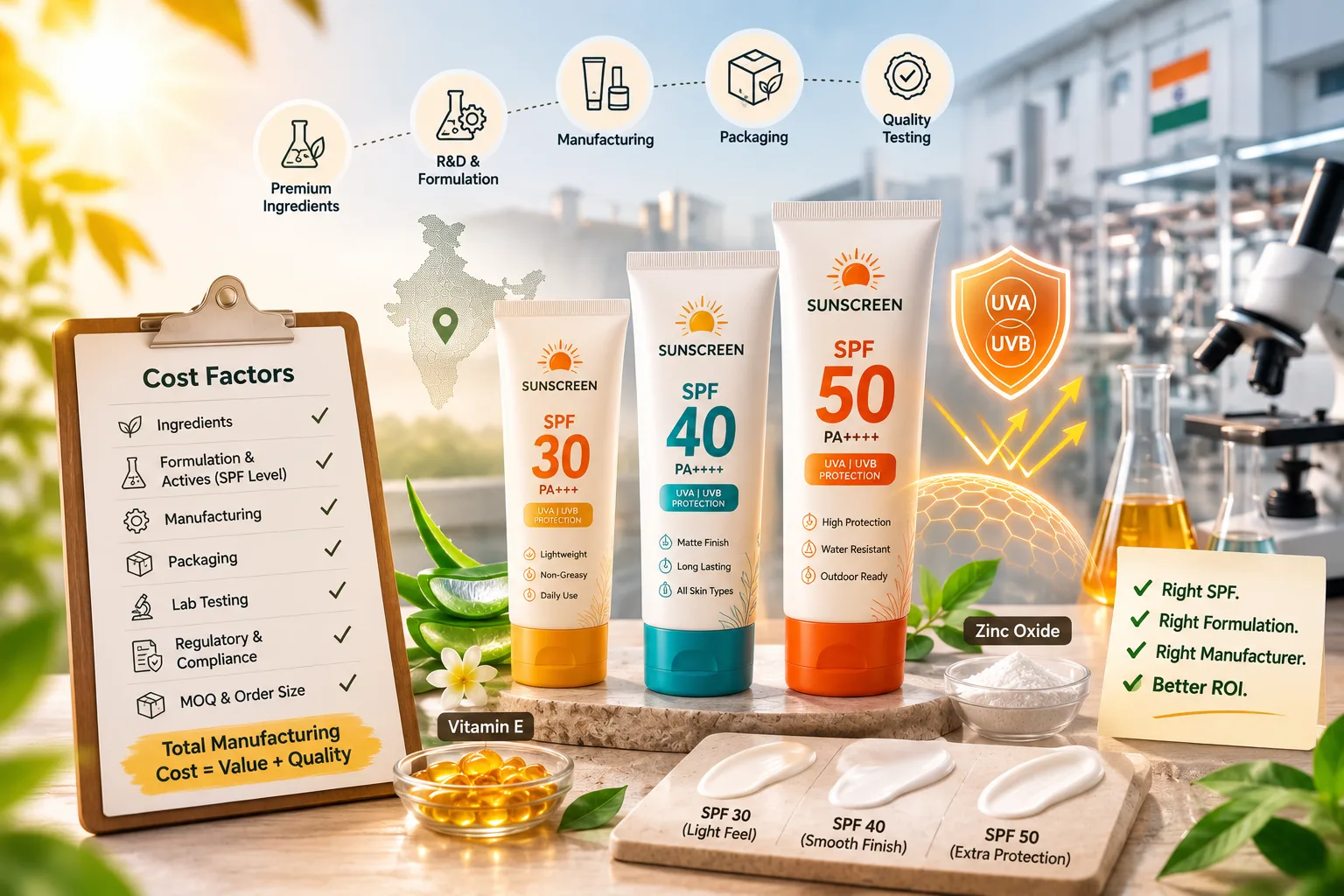
- UV filter system, the biggest single cost driver, affecting texture, stability, and protection characteristics, and governed by Indian Standards and Drugs and Cosmetics compliance.
- Formulation type, gel (lightweight, matte, oily/acne-prone skin), lotion (spreadable, everyday use), or cream (richer, moisturizing) each carry different manufacturing complexity at the same SPF.
- Cosmetic texture, white cast, stickiness, and pilling under makeup can sink an otherwise compliant product; protection alone isn’t enough.
- Packaging, standard tubes with a strong label are usually more economical for startups than custom bottles or airless packaging, provided the formula and packaging are compatible.
- MOQ, a lower per-unit price at a large MOQ can mean more total capital than a slightly higher price at a small batch. Evaluate MOQ and unit cost together, not separately.
- Testing and validation, SPF claims need documented test support; increasingly, customers ask brands directly for SPF and UVA test reports, so build the product and the claim strategy together, not sequentially.
- Customization, the spectrum runs from “ready formula + your branding” to fully custom actives, texture, and packaging. Your first SKU doesn’t need every component customized.
Private Label vs. Custom Sunscreen
The trade-offs here follow the same logic as private label vs. custom formulation generally: private label gets you to market faster with lower development risk, while custom formulation buys real differentiation, a specific texture, filter combination, or finish, at the cost of more R&D, samples, and time.
For sunscreen specifically, private label is a sensible starting point if the available formula genuinely fits your target customer’s skin type and expectations. Don’t customize just to look premium on paper.
Building Your Own Cost Sheet
Don’t ask “what’s the price of SPF 50?” Build a proper cost sheet for your specific SKU instead:
| Cost component | Budget |
| Formulation/sample development | Contact Manufacture |
| Bulk manufacturing | Contact Manufacture |
| Primary packaging (tube/bottle) | Contact Manufacture |
| Labels & cartons | Contact Manufacture |
| Testing/documentation | Contact Manufacture |
| Freight | Contact Manufacture |
| Total batch cost | Contact Manufacture |
| Quantity produced | Contact Manufacture units |
| Landed cost per unit | Contact Manufacture |
Then add your commercial costs separately, marketplace fees, advertising, influencer spend, shipping, and returns, to get your real cost of selling, not just the factory cost.
Choosing a Manufacturer
The full manufacturer-evaluation checklist, MOQ, GMP/quality systems, samples, formulation capability, packaging, lead times, and scalability, applies here exactly as it does for third-party cosmetic manufacturing generally. For sunscreen specifically, add these to your questions:
- Can you manufacture SPF 30, 40, and 50, in both gel and lotion formats?
- What testing supports the SPF claim, and is UVA documentation available?
- Is testing, packaging, and freight included in the quoted price, or billed separately?
Three manufacturers quoting three different unit prices aren’t automatically ranked cheapest to most expensive, the one with unclear documentation and long response times can end up costing more than a slightly pricier option with better samples and communication. Compare total cost + quality + compliance + reliability, not the unit price in isolation.
How to Reduce Costs Without Cutting Quality
- Start with one hero SKU, “SPF 50 Matte Sunscreen Gel for Oily & Acne-Prone Skin” is a clearer, cheaper launch than six SPF/format variants at once.
- Use standard packaging with a strong label rather than custom-printed bottles that raise your MOQ.
- Customize only what improves performance, sensory experience, differentiation, or target-market relevance, not customization for its own sake.
- Ask for pricing at multiple volumes (initial batch, repeat batch, higher volume) so you understand how your unit economics improve as you scale.
For the full validate → launch → scale sequence, see the private label launch guide, the same process applies to a sunscreen SKU as any other private label product.
Why Shukti Food Pharma for Sunscreen
Shukti Food Pharma manufactures SPF 30 gel, SPF 40 matte, SPF 40 moisturizer, and SPF 50 lotion and matte sunscreen through GMP-certified processes, with private label and custom formulation options. The stated workflow is straightforward: choose a product, request samples and pricing, validate and approve, then produce and dispatch, with artwork guidance and batch documentation supported throughout. Browse the skincare and sunscreen range, see the Karnal facility on Google Maps, or request samples and pricing.
FAQs
What is the cost of manufacturing sunscreen in India?
There’s no universal price, it depends on SPF claim, formulation, UV filters, format, packaging, MOQ, and testing. Request a detailed SKU-specific quotation rather than relying on a generic industry figure.
Is SPF 50 more expensive to manufacture than SPF 30?
Not necessarily. Formulation, filter system, texture, and testing usually matter more than the SPF number itself.
What is the MOQ for private-label sunscreen?
It varies by manufacturer and product, some list quantities like 5,000 pieces publicly, but always confirm the MOQ for your specific SKU and packaging.
What’s the difference between private-label and custom sunscreen?
Private label uses an existing formulation branded for you; custom sunscreen is developed or modified to your specification, which increases time and cost.
Do SPF claims need testing?
Yes, the BIS sunscreen standard specifies SPF ranges and the test methods required to support each claim.
Which is better for a startup: SPF 30 or SPF 50?
It depends on your target customer, price point, and positioning, not the SPF number alone. Base the decision on the full formulation and market opportunity.
Final Takeaway
Don’t start with “who gives me the cheapest SPF 50?” Start with “what does my customer actually need, and what will it cost to manufacture correctly?” Then compare manufacturers on formula, SPF testing, texture, MOQ, packaging, documentation, and total landed cost, not the number on the tube.
If you’re exploring private-label sunscreen, check Shukti Food Pharma’s SPF 30, 40, and 50 range and request current samples, MOQ, and SKU-specific pricing.